
How to Build Your First Software Project as a College Student: Turn Your Coding Knowledge into Something Real
Learning programming inside a classroom and creating something that actually works are two very different experiences. You might understand Python concepts, write Java programmes or practise database queries, but the real excitement begins when you combine these skills to create your own application.
How to Build Your First Software Project as a College Student is something every aspiring developer should explore. Your first project does not need to be an impressive commercial application. It could be a simple website, a student record system or a tool that solves a small everyday problem.
What matters is that you create something independently, understand how it works and learn from the challenges along the way.
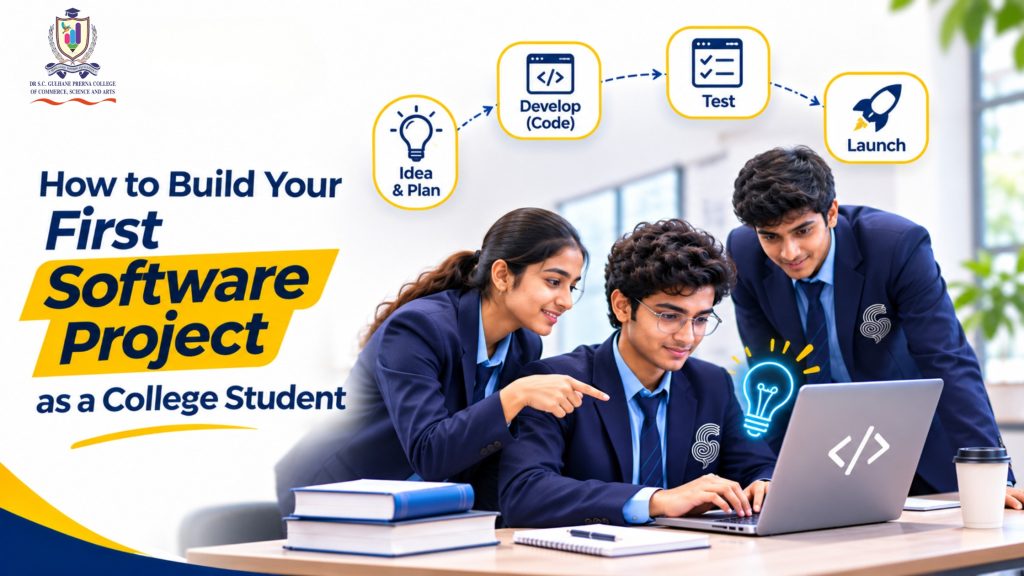
Here is a practical roadmap to help you get started.
1. Find a Real-Life Problem Worth Solving
Before choosing a programming language, look around and identify problems that people experience regularly.
For instance, students sometimes struggle to remember assignment deadlines, organise study materials or manage monthly expenses. These everyday situations can become interesting software development opportunities.
Consider these project concepts:
- Smart Study Planner:Helps students organise subjects, assignments and examination dates.
- Campus Lost and Found Portal:Allows students to report and search for misplaced belongings.
- Digital Canteen Ordering System:Displays food items and manages student orders.
- Personal Skill Tracker:Records completed courses, technical skills and learning goals.
- College Placement Preparation Portal:Organises interview questions, aptitude practice and preparation resources.
Choose a project that you would genuinely enjoy developing. Personal interest makes it easier to remain motivated when coding becomes challenging.
2. Build Your Technology Foundation Before Starting
A common beginner mistake is collecting too many programming tutorials without actually creating anything.
Instead, identify the technologies required for your chosen application.
For a basic web-based project, you might need:
- HTML to organise webpage content.
- CSS to create an attractive interface.
- JavaScript to introduce interactive features.
- Python or PHP for server-side operations.
- MySQL to manage stored information.
You can also use Visual Studio Code as your code editor and GitHub to maintain your project files.
You do not need to master every technology before beginning. Learn the concepts required for your first feature and apply them immediately.
3. Convert Your Idea into a Simple Development Blueprint
A good application starts with a clear plan.
Imagine that you want to develop a digital assignment tracker. Before writing code, decide what users should be able to do.
They might need to add an assignment, enter its submission date, check pending tasks and mark completed work.
Now divide the application into smaller sections:
- User interface.
- Assignment entry form.
- Task storage.
- Pending and completed task display.
- Editing and deletion options.
This approach makes development manageable and helps prevent confusion halfway through the project.
You can even draw rough screen designs in a notebook before building the actual interface.
4. Develop Your First Working Version Step by Step
Do not attempt to create the complete application on your first day.
Start with one feature and make sure it works properly. For an assignment tracker, begin by creating a form that accepts an assignment name and deadline.
Next, display the entered information on the screen. Once this works, introduce data storage and additional functionality.
Keep testing your work as you develop.
You will probably encounter unexpected errors, broken layouts or functions that do not behave as expected. Instead of immediately replacing your code, investigate the reason behind the problem.
This process develops logical thinking, patience and independent problem-solving abilities.
5. Make Your Student Project Presentable and Useful
A working application becomes more valuable when another person can understand and use it.
Pay attention to the small details that improve the user experience:
- Use readable text and organised layouts.
- Add clear labels to buttons and forms.
- Display helpful messages when information is missing.
- Test your application on different screen sizes.
- Remove unnecessary features that make navigation confusing.
Once your application is ready, prepare a project report explaining its objective, technologies, development process and results.
Upload the source code to GitHub and include screenshots. This gives you something concrete to demonstrate during internship applications and technical interviews.
6. How College Learning Can Help You Become a Better Developer
Software development involves more than memorising programming syntax. Students need opportunities to apply concepts, understand technical problems and work through practical challenges.
At Dr. S. C. Gulhane Prerna College of Commerce, Science and Arts, Nagpur, students interested in technology can explore academic programmes such as BCA, B.Sc. Computer Science and B.Sc. Information Technology.
These programmes provide opportunities to develop knowledge in programming, computing concepts and information technology. Practical sessions and project-based learning can further help students connect classroom concepts with real-world applications.
Students can learn more about the college and its academic offerings through https://prernacollegecsa.org/.p
\
6. How College Learning Can Help You Become a Better Developer
0p7. Take Your First Project Beyond the Classroom
Once you complete your initial application, do not leave it sitting in a folder on your computer.
Show it to classmates, ask teachers for suggestions and identify features that could make it better.
You can also participate in hackathons, explore open-source communities and practise coding challenges. Gradually, build projects with different technologies so your portfolio demonstrates a wider range of abilities.
Remember, employers are interested not only in the technologies you know but also in how you approach problems and explain your work.
Conclusion: Your First Project Is the Beginning, Not the Destination
Every skilled developer once struggled with a first programme, an unexpected error or an unfinished application. The difference comes from continuing to experiment and improve.
As a college student, you have the opportunity to turn academic learning into practical achievements. Begin with one meaningful idea, develop it patiently and document what you learn.
Your first software project may not change the world, but it can change the way you approach technology, problem-solving and your future career.