
How Do Websites Work? A Beginner's Guide to Web Development
How Do Websites Work? A Beginner’s Guide to Web Development is an interesting topic for students who want to understand how the internet connects people, businesses and information. Every day, millions of Indians use websites for online shopping, education, banking, entertainment and communication. However, very few users think about what happens behind the screen when they open a website.
A website is more than a collection of attractive pages. It involves programming languages, servers, databases and different technologies working together. Understanding these basics can help students explore web development as a practical career option and develop the technical skills needed in today’s digital world.
Understanding the Basic Structure of a Website
A website is a collection of connected web pages available through a domain name. Each page contains information that visitors can access using an internet browser such as Google Chrome, Firefox or Microsoft Edge.
For example, when someone visits an educational website, they might explore admission details, courses, faculty information and contact pages. These sections are organised to make information easy to find.
Behind this simple experience, developers create instructions that tell browsers what to display and how visitors can interact with different elements.
How Browsers and Servers Communicate
Have you ever wondered what happens after entering a website address into your browser?
The process involves two important components: the browser and the web server.
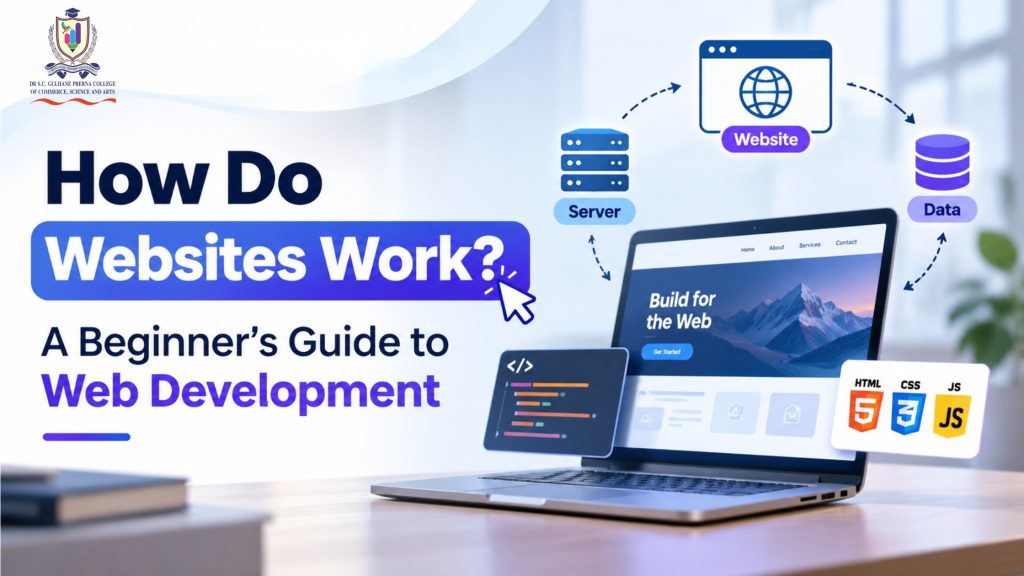
A browser sends a request to the server where the website’s files are stored. The server processes the request and sends the required information back. The browser then assembles these files and displays the website on the screen.
Domain Name System (DNS) helps connect a website’s readable domain name with the server’s internet address. Communication between browsers and servers generally takes place through HTTP or its secure version, HTTPS.
This entire process happens within seconds, allowing users to access websites from different locations across India.
Three Essential Technologies Behind Every Website
Web development becomes easier to understand when students learn about three fundamental technologies.
HTML (HyperText Markup Language): HTML creates the basic structure of a webpage. It organises headings, paragraphs, images, links, tables and other content.
CSS (Cascading Style Sheets): CSS controls the visual appearance of a website. It helps developers select colours, fonts, spacing, layouts and responsive designs that work across different screen sizes.
JavaScript: JavaScript adds interactive features to webpages. It makes activities such as opening menus, validating forms, displaying messages and updating content possible.
These technologies work together to turn basic information into an interactive digital experience.
Front-End and Back-End Development Explained
Website development is generally divided into two major areas: front-end and back-end development.
Front-end development focuses on everything visitors can see and use. It includes website layouts, navigation menus, buttons, images and mobile-friendly designs. Developers use HTML, CSS and JavaScript to build these elements.
Back-end development handles the operations that happen behind the scenes. It manages user accounts, login systems, database connections, payment processing and information requests.
For instance, when a student fills out an online college admission form, the front end displays the form, while the back end processes and stores the submitted information.
Both areas are important for building websites that function smoothly and provide a reliable user experience.
Why Databases and Web Hosting Matter
A website often needs a place to store information. This is where databases become useful. They organise details such as customer records, student information, product listings and login credentials.
Web hosting makes website files accessible through the internet. After development, website owners purchase hosting services and connect their domain names so visitors can access the website whenever required.
Security, regular backups, website speed and reliable hosting are also important considerations when managing a professional website.
Career Opportunities in Web Development for Indian Students
As businesses, educational institutions and service providers continue building their online presence, web development offers several career possibilities.
Students interested in technology can explore roles such as:
- Front-End Developer
- Back-End Developer
- Full-Stack Developer
- WordPress Developer
- UI Developer
- Web Application Developer
Students can begin by learning HTML, CSS and JavaScript, followed by database management, programming concepts and practical projects. Creating a personal portfolio or a simple college website is a useful way to demonstrate their abilities.
Conclusion
Understanding website development is the first step towards exploring how digital platforms are created and managed. From browser communication to coding, databases and hosting, every component contributes to the final website experience.
For students interested in computer applications and technology, learning these fundamentals can build a strong foundation for future opportunities. With consistent practice, curiosity and practical exposure, beginners can gradually turn their interest in technology into valuable professional skills.